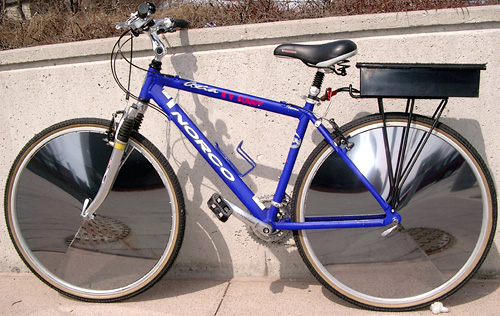
Bottom line: These "solar panels" are fake. Even if such wheel-disc solar panels were possible, they would require nearly 20 hours of charging for every 1 hour of riding.
I've been contemplating publishing my impressions of this "solar powered" bike since I started this blog over a year ago. I've held back because I didn't think I could talk about it without coming across as petty and jealous. In the interest of fair play, I'll start by discrediting myself and confessing that I'm cranky about this project being the top Google result for the query term solar bike. I don't think it deserves this level of attention.
Here are two major design problems the inventor would need to overcome to build a working prototype.
- How do you transfer power from the moving solar cells in the wheel to the stationary forks? Magnetic induction? Inefficient and heavy. Brushed commutator? Inefficient, vulnerable to dirt and moisture. Hub motors solve this problem by having the wires attached through a hollow stationary axle and the permanent magnet parts of the motor (armature) rotate around the electromagnetic windings. This doesn't work if your current source is moving and your batteries are stationary. And it certainly doesn't work if you have a quick-release mechanism on the wheels like the bike pictured. The skewers in the center of the hollow hubs are right where the wires would have to be. Now that I think about it, the bike pictured above cannot have a hub motor hiding in the wheel (as the inventor claims) because hub motors cannot use quick-release levers.
- Where do you get photovoltaic thin film which can be cut into a circle? I'm not saying it couldn't be manufactured but I attended the InterSolar trade show in San Francisco three weeks ago. 444 exhibitors showing off the latest solar technology and I didn't see one product which can be cut like this. In the Discovery Channel video on this page, the inventor holds a real PowerFilm thin film cell in his hand but the shiny metallic film in the wheels appears to be cheap reflective mylar held together with scotch tape. But it was on TV so it must be real, right?
Over two years have passed since this tantalizing photo surfaced and the website still doesn't offer to sell anything resembling the bike with the shiny wheel discs. The owner appears to be offering a cheap Chinese e-bike with a 200 or 300 watt front hub motor and a 5 watt solar panel strapped to the rear rack for a bargain price of $1800. A comparable ebike sans solar sells at Wallmart for under $300. Something tells me the shiny wheel idea didn't work out.
But let's be generous and assume that our intrepid inventor somehow overcame these two engineering hurdles. The numbers show that this idea still doesn't work. For the purposes of this exercise, I'll define "work" as having a design where the solar charging adds enough value to the non-solar enhanced ebike to justify the added cost and expense.
Let's start by calculating the surface area of the wheel discs. Measuring one of my 26" wheels, the inner diameter is 21". The area of a circle is πr2 so we have 3.14 x (21 inches/2)2 = 346 in2 = 0.223 m2. I'll be charitable and pretend that the parts of the panel obscured by the front fork, chain stay and seat stay don't reduce the panel's output.
At 1000 W/m2, we would have 1000 x 0.223 = 223 watts theoretical output at 100% efficiency. Thin film modules have efficiencies from 3.8% to 5.9% (see the full-screen table in this post for details). Using the best-case scenario of 5.9% this gives us 223W x 5.9% = 13 watts per wheel or 26 watts total. Note that I am not counting both sides of each wheel because only one side can face the sun at any given time.
Now, let's consider the vertical orientation of these solar panels. Using the U.S. Department of Energy redbook data on flat-plate solar collectors for my locale (San Francisco Bay Area), we get an average of 2.7kWh/m2/day for a 90° tilt collector facing South. That means our shiny wheel discs would produce 2700 Wh x 0.223 m2 x 5.9% panel efficiency x 2 wheels x 90% charging efficiency = 64 Wh/day. At an estimated 20 Wh/mile for a gearless hub motor on flat ground without pedalling, this gives us a whopping 3 miles on an all-day solar charge. Maybe twice that if you pedal.
If you lay the bike flat on the ground (0° tilt) from sun up to sun down in the summer, you get an average of 7.1 kWh/m2/day or 7100 Wh x 0.223 m2 x 5.9% panel efficiency x 2 wheels x 90% charging efficiency = 168 Wh/day. Good for about 8.4 miles.
So there you have it, 3-8 extra miles per day under average charging conditions. You'll get a little more on clear, sunny days and a lot less on cloudy, rainy days. Put another way, you need 15-20 hours of charging for every 1 hour of riding. If this was your only solar option, your money would be much better spent on upgrading to slightly larger and/or more efficient batteries and skipping the shiny wheel discs. Luckily, there are many other solar options out there.
Security warning: The ordering page on this site is not secure (does not use SSL). Unacceptable. Never order anything online if you don't see HTTPS at the beginning of the page address.

 Short Answer